In today's landscape of 800V high-voltage platforms, high-power-density server power supplies, and energy storage inverter industries, engineers face a common "bottleneck": the ultimate challenge of power density. As digital power supplies evolve toward miniaturization and high integration, the loss and heat dissipation efficiency of magnetic components often become the final "thermal wall" restricting system performance.
Traditional ferrite transformers suffer from significant magnetic loss under high-frequency operation and have limited heat dissipation paths, leading to localized "Hot Spots." This not only reduces efficiency but also directly threatens system reliability. How can we achieve the perfect balance between ultra-low loss and extreme heat dissipation within a limited volume? This is exactly the industry challenge Magsonder and Le Meilleur aim to solve with the LMT-T64 Nanocrystalline Transformer.
The Innovation
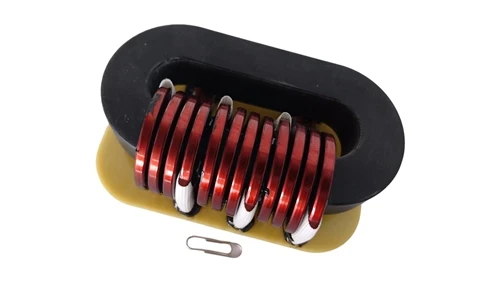
The core innovation of the LMT-T64 lies in moving beyond the traditional label of magnetic components as mere "energy storage devices." Through rigorous LMT processes, it has been upgraded into an integrated system combining magnetic circuits, thermal conduction, and structural protection.
T64 Nanocrystalline Core Architecture: Moving away from traditional magnetic materials, it utilizes a Nanocrystalline material with high magnetic permeability and low coercivity. This material exhibits extremely low Hysteresis Loss in high-frequency environments, reducing heat generation at the source.
Active Thermal Management Logic: This product no longer relies on passive air convection. Instead, it utilizes an Aluminum Alloy Case combined with high-thermal-conductivity filling.
High-Conductivity Vacuum Potting: A key innovation is the use of specialized potting resin with a thermal conductivity of 1.5W/(m·K). Through a Vacuum process, internal microscopic air bubbles are completely eliminated, creating the shortest path to conduct heat from the core and windings to the metal shell.

How It Works
The operational logic of the LMT-T64 can be broken down into the coupling of three dimensions:
1. Precision Design of Magnetic Circuits and Windings
According to the specifications, the transformer features a Turns Ratio of 5:20.
N1 Winding: Uses a 3-strand parallel-wound 2UEW-H 0.2*200C membrane-covered wire, ensuring the insulating film remains undamaged and significantly reducing losses caused by the skin effect.
Uniform Double-Layer Winding: Two layers of uniformly distributed windings optimize the Leakage Inductance to approximately 6.3μH±10%, effectively improving energy conversion efficiency.
2. Physical Structure: Vibration Resistance and Alignment
The position of the transformer within the aluminum shell is strictly regulated, requiring it to be neither tilted nor displaced. This absolute spatial fixation ensures symmetrical magnetic circuit distribution and allows the potting resin to encapsulate components evenly, preventing localized heat accumulation.
3. Multiple Insulation and Reliability Protection
Sleeve Protection: All leads are encased in specialized Sleeves (Fiberglass), with the distance from the sleeve end to the terminal top strictly controlled at 50-70mm.
Hexagonal Crimping: The output terminals (RNBS8-4) must be crimped using a Hexagonal Die. This method ensures minimal contact resistance while reducing terminal width to accommodate highly integrated wiring spaces.

Use Cases
Scenario 1: Digital Power Systems
In typical applications like those from E-Nergy Digital Power, transformers must process high-frequency pulse signals. With a stable inductance of 1.24mH±30% and excellent dielectric strength (N1-N2 withstands 2000Vac/50Hz/3s), the LMT-T64 maintains high-precision power output under complex digital control.
Scenario 2: 800V On-Board Chargers (OBC) and Automotive DC-DC
Automotive environments are extremely sensitive to vibration and temperature fluctuations. The LMT-T64's aluminum shell is matched with a dedicated Waterproof Strip, which, combined with the mechanical strength provided by vacuum potting, offers excellent vibration and moisture resistance-ideal for demanding Automotive applications.
Future Outlook
As wide-bandgap semiconductors (such as SiC and GaN) become more prevalent, increasing switching frequencies place higher demands on magnetic components. Magsonder's technology demonstrates a clear future trend: Modularization of magnetic components and integration of thermal paths.
In the future, transformers will no longer be "islands" on the PCB. Instead, through advanced thermal materials and patented packaging architectures, they will directly participate in the system's thermal balance management. The Architecture optimization approach seen in the LMT-T64 provides solid hardware support for the industry's leap from 2kW densities to 5kW or even 10kW.
The LMT-T64 Nanocrystalline Transformer is more than just a material upgrade; it is a deep process reconstruction for high-efficiency, long-life digital energy systems.