In the global transition toward renewable energy, residential photovoltaic (PV) and energy storage systems (ESS) are evolving rapidly toward higher power density, smaller footprints, and superior conversion efficiency.
Within the popular 3.5kW to 5kW power range for residential inverters, output filter loops and DC-DC boost circuits face severe electromagnetic and thermal demands. As the primary energy-storage and filtering component, the power choke/inductor often dictates the overall efficiency, thermal ceiling, and physical dimensions of the inverter.
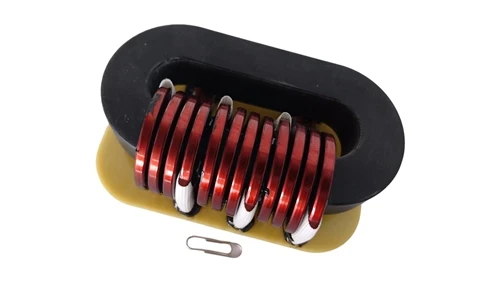
This article dives into the CD-Type Amorphous High-Current Power Inductor-custom-built for 3.5kW inverter circuits-and examines how its amorphous alloy core and enamelled flat copper ribbon windings push past the design constraints of traditional magnetic components.
1. The Demands on Power Inductors in 3.5kW Inverters
Under the typical operating conditions of residential storage inverters (off-grid and hybrid topologies), a power choke must handle several critical challenges:
Continuous High Current and Peak Surge Handling: At a 3.5kW rated output, the inductor must continuously pass 40A to 60A RMS currents while withstanding even higher transient pulse spikes during sudden load changes or startup.
High-Frequency Switching Loss: Modern inverters commonly operate at pulse-width modulation (PWM) switching frequencies in the tens of kilohertz (kHz). These high-frequency ripple currents cause significant core losses and copper losses.
High Anti-Saturation Margin (Worst-Case Working Conditions): Under elevated ambient temperatures and peak overload conditions, the magnetic core must not undergo sudden magnetic saturation. Core saturation can trigger current spikes that risk damaging active power devices (such as IGBTs or SiC MOSFETs).
Thermal and Spatial Constraints: With limited space inside the inverter housing, the inductor itself must generate minimal heat while offering an efficient path for thermal dissipation.

2. Key Architectural Innovations and Structure Analysis
① CD-Type (Race-Track/Oval) Amorphous Alloy Core
Traditional high-power chokes frequently use ferrite or iron powder cores. However, ferrite features a low saturation flux density ($B_s \approx 0.4\text{--}0.5\text{T}$), making it prone to saturation under heavy DC bias. Iron powder cores, on the other hand, suffer from higher core losses at switching frequencies in the tens of kHz.
High Saturation Flux Density ($B_s \ge 1.5\text{T}$): Amorphous alloy exhibits a much higher $B_s$ than ferrite, allowing the core to handle significantly larger DC bias currents without saturating, which helps reduce physical core size.
CD-Type Oval Closed Magnetic Circuit: The oval race-track geometry shortens the magnetic path and reduces stray flux (improving EMI performance). It also aligns with the shape of flat ribbon windings, maximizing space utilization.
Low High-Frequency Core Loss: Due to its ultra-thin ribbon structure and high electrical resistivity, amorphous alloy reduces high-frequency eddy current losses to a fraction of traditional materials, preventing core overheating.
② Enamelled Flat Copper Ribbon (Edge-Wound) Winding
Standard round wire suffers from severe skin effect and proximity effect at high frequencies and high currents, which reduces the wire's effective cross-sectional area, spikes AC resistance, and generates excessive heat.
Edge-Winding Technique: Using rectangular flat copper ribbon with a high aspect ratio tightly wound on edge significantly improves the slot fill factor-increasing space efficiency by 20% to 30%+ compared to round wire.
Ultra-Low Direct Current Resistance (Ultra-low DCR): The large cross-sectional area of the flat copper ribbon dramatically lowers DCR, directly cutting down $I^2R$ conduction losses.
Superior Thermal Performance: The enlarged surface area of the flat ribbon mitigates the high-frequency skin effect and speeds up heat dissipation into the surrounding air or potting material, maintaining a low temperature rise under forced air or natural convection.
③ FR4 Baseboard and Sturdy Terminal Pins
FR4 Epoxy Substrate: Offers high temperature resistance and dielectric strength, providing mechanical support and electrical isolation for heavy-gauge coils.
Direct-Insert Heavy Pins: Large-cross-section terminal pins reduce contact resistance at the solder joint and withstand high vibration, ensuring reliable manual or automated PCB assembly.

3. Structural Evolution: From Test Samples to Production Potting
To support customers through every stage of inverter development, this power choke offers a flexible structural upgrade path:
Open Evaluation Sample:
Shown in its unpotted form, this configuration allows engineering teams to attach thermocouples for thermal testing, perform electromagnetic compatibility (EMC) evaluations, and verify mechanical fit during initial prototyping.
Potted Assembly with Aluminum Casing:
For final mass production, the inductor can be housed in a precision aluminum shell and encapsulated with high-thermal-conductivity epoxy or silicone potting. This provides three major benefits:
High Ingress Protection: Complete resistance to dust, moisture, and salt spray for harsh outdoor PV environments.
Enhanced Thermal Management: Efficiently transfers heat from the core and windings through the aluminum casing to the system heatsink.
Acoustic Noise Dampening: Potting suppresses magnetic magnetostriction vibration, eliminating audible hum during high-frequency operation.
4. Key Application Scenarios
Beyond its primary role as a DC-AC output filter choke in 3.5kW residential energy storage inverters, this inductor is widely deployed in other high-power electronics systems:
Photovoltaic & Off-Grid/Hybrid Inverters: Boost converters and AC output LC filter circuits.
Bi-directional Power Conversion Systems (PCS): High-current charging and discharging paths in battery storage systems.
High-Power Industrial Supplies & DC-DC Converters: High-power-density switch-mode power supplies (SMPS) and heavy-duty PFC (Power Factor Correction) chokes.
EV & Industrial Drives: On-board chargers (OBC), industrial welding equipment, and variable-frequency drives (VFDs).
5. Summary
For 3.5kW solar storage inverters aiming for higher efficiency, thermal reliability, and power density, the CD-Type Amorphous Flat Ribbon Power Inductor delivers a balanced magnetic solution. It reconciles high-frequency loss reduction, thermal control, and high-current saturation resistance within a compact footprint.
Magsonder specializes in high-frequency power magnetic components, offering custom core selection, thermal simulation analysis, and rapid prototyping tailored to your specific electrical parameters (inductance, rated current, switching frequency, and temperature rise limits) and spatial constraints. Contact our engineering team to request sample units and test data.