Abstract
In the realm of modern power electronics-characterized by soaring switching frequencies and shrinking PCB real estate-the inductor is often the primary bottleneck in system efficiency.
While Faraday's law provides the physical foundation, the modern engineer must navigate a labyrinth of non-linear core saturation, frequency-dependent AC losses, and parasitic coupling. This article scrutinizes the inductor not as a passive ideal component, but as a complex energy-storage system characterized by its material science and electromagnetic constraints.

The Physics of Energy Storage
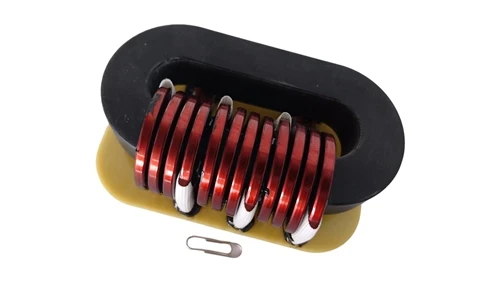
An inductor is fundamentally a transducer that architects a magnetic field to store energy. Unlike a capacitor, which leverages the potential energy of an electric field, an inductor utilizes the kinetic energy of moving charges.
At the silicon level, the inductance L is an engineered function of geometry and permeability mu ;. The core material's magnetic domains define the saturation current Isat . Surpassing this limit yields a catastrophic drop in inductance, often leading to power stage failure.
The energy stored is defined by E = ½LI2 . In high-density converters, maximizing this energy while minimizing the physical volume remains the core design paradox.
Modeling Non-Ideality
In high-frequency applications, such as GaN-based resonant converters, the "ideal inductor" does not exist. We must scrutinize the Lumped Element Model to understand performance limitations.
DC Resistance (DCR) causes Ohmic heating in copper windings, which limits the continuous current rating Irms . Skin Effect results in current crowding at the conductor surface, causing AC resistance to soar at MHz frequencies. Core Loss, driven by Hysteresis and Eddy currents in the magnetic material, becomes the dominant thermal constraint in high-frequency switching.
By validating these parameters through PSpice simulations or network analyzers, engineers can predict the Self-Resonant Frequency (SRF), beyond which the component acts as a capacitor.

From Iron Powder to Thin-Film Magnetics
The transition from Silicon to Wide Bandgap (WBG) semiconductors like SiC and GaN has forced an overhaul of inductor design. Soft Ferrites offer high permeability but low Isat , making them ideal for signal integrity and low-power EMI filtering.
Metal Composite and Powder Cores provide a "soft" saturation characteristic, which conserves system stability during transient overloads. Modern SoC designs are now moving toward Inductor-on-Chip (PwrSoC) technology, utilizing thin-film magnetic alloys to achieve pico-henry precision at GHz speeds.
Selecting the Optimal Topology
When architecting a power stage, the inductor choice determines the Ripple Current ΔIL ; and, consequently, the Output Ripple Voltage.
A common engineering rule of thumb for most Buck converters suggests sizing the inductor to maintain a ripple current that is 20% to 40% of the maximum load current. However, in specialized designs for ultra-low noise medical equipment, engineers might refine this by opting for a larger inductance to accelerate the transition into Continuous Conduction Mode (CCM), thereby reducing EMI.
The Future of Magnetic Components
As the industry moves toward 2nm process nodes and AI-driven power demands, the inductor remains a "macro" component in a "micro" world. Future breakthroughs will likely not come from the coil geometry itself, but from synthesizing new nanocrystalline materials that offer higher flux density with lower high-frequency hysteresis.
The inductor is no longer just a wire around a core; it is a precisely calibrated electromagnetic filter that defines the boundaries of power density and thermal management in the next generation of electronics.