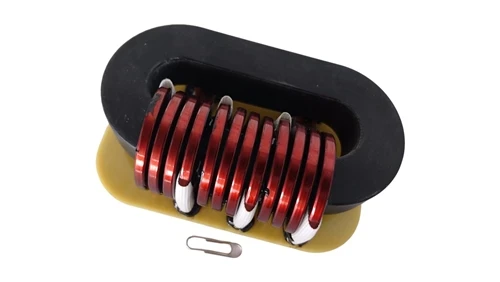
In modern switching power supply (SMPS) design, magnetic components play a core role in energy conversion and electrical isolation. Among the various magnetic core geometries, the PQ-type high-frequency transformer has become a "star component" in medium-to-high power density power supplies due to its unique contour design and exceptional electrical performance.
Today, combined with physical component details, let's take an in-depth look at the structural advantages, application scenarios, and core characteristics of this vertical through-hole high-frequency switching power supply transformer.

I. Product Appearance and Structural Identification
When examining a transformer, its pedigree can first be judged from its exterior details:
Core Shape (PQ Core): It features typical characteristics of "a raised central bobbin with magnetic side shields". This geometric structure gives the core excellent closed-magnetic-circuit properties.
Pins and Mounting Structure: It adopts a vertical through-hole soldering pin design. The neat arrangement of the pin terminals allows for direct plug-in soldering onto the PCB, balancing mechanical stability with assembly convenience.
II. Core Application Scenarios
Thanks to its high density, small footprint, and outstanding safety isolation capabilities, PQ-type high-frequency transformers are widely used in various compact, high-reliability power supplies:
Medium and Low-Power Chargers and Adapters: Widely utilized for efficient charging and power adaptation in various digital products and small home appliances.
LED Driver Power Supplies: Meets the rigorous demands of lighting systems for long life, stable constant current, and compact spaces.
Industrial Control and Home Appliance Mainboard Power Supplies: Provides continuous and stable power for various low-power industrial control power modules, home appliance mainboards, and security monitoring equipment.
Energy Storage BMS Auxiliary Power Supplies: Provides reliable electrical isolation and auxiliary power within Battery Management Systems (BMS).

III. Why Choose PQ-Type? Three Core Product Characteristics Analyzed
Compared to conventional magnetic cores, PQ-type transformers are favored in the switching power supply field primarily due to their hard-core performance advantages:
1. Superior Magnetic Circuit and Loss Performance
Large Cross-Sectional Area and Short Magnetic Path: The center leg of a PQ core has a relatively large cross-sectional area and a short magnetic path. This means that at the same power level, it effectively reduces core loss and generates less heat during high-frequency operation.
Built-In Magnetic Shielding: The side-enclosed design forms a well-closed magnetic circuit, which significantly reduces magnetic leakage and makes electromagnetic interference (EMI) easier to control, meeting strict EMC standards.
2. Efficient Safety Isolation and High-Frequency Conversion
Safety Isolation: The bobbin is typically made of high-temperature-resistant insulating materials, and multiple layers of insulating tape are used between the primary and secondary windings. This ensures superior electrical isolation performance, easily meeting the withstand voltage and creepage distance requirements of high and low-voltage safety standards.
High-Frequency and High-Efficiency: Perfectly adapted to high-frequency switching circuits ranging from tens of kHz to MHz, efficiently accomplishing voltage step-up/step-down and power transmission with high overall conversion efficiency.
3. High Reliability and Flexible Customization
Low Temperature Rise and Long Lifespan: Due to its compact structure and high power density, it exhibits extremely low temperature rise and exceptional reliability during prolonged continuous operation.
Highly Customizable: The turns ratio, inductance, and pin layouts can be flexibly adjusted according to the customer's actual electrical requirements, making it a customized magnetic device tightly aligned with specific power supply architectures.
Conclusion
As the "behind-the-scenes hero" in switching power supplies, the PQ-type high-frequency transformer continues to shine in consumer electronics, industrial control, and new energy storage sectors through its high magnetic efficiency, low EMI, and compact vertical structure. During power supply architecture design, rationally evaluating and selecting high-quality PQ transformers often brings a qualitative leap to the overall system's efficiency and stability.