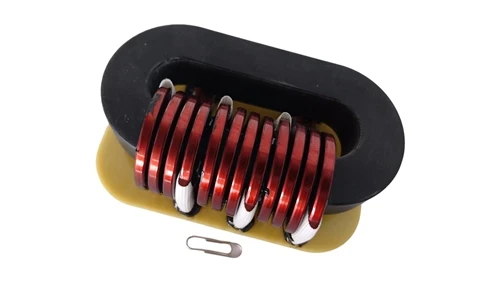
In today's pursuit of ultra-high Power Density, power engineers are caught in a "zero-sum game between materials and space." Have you ever faced this dilemma: choosing Ferrite to reduce high-frequency losses, only to find it saturates (Magnetic Saturation) instantly as current increases, forcing you to enlarge the inductor size? Or switching to a Metal Powder Core for its excellent DC Bias characteristics, yet having to endure high material costs and the EMI (Electromagnetic Interference) challenges caused by fringing fields?
This predicament is particularly prominent in applications with extreme efficiency and size requirements, such as PV Inverters and On-Board Chargers (OBC). How can we achieve the ultimate "downsizing" of inductors without sacrificing efficiency? Magsonder's latest patent provides the answer.
The Innovation
The solution proposed in US11430597 breaks the limitations of single-material designs, achieving a leapfrog improvement in performance through an innovative Hybrid Magnetic Architecture.
The core of this technology lies in the "heterogeneous integration" of magnetic materials with different physical properties, combining their respective strengths:
High-Saturation Middle Column: The center column surrounded by the coil utilizes a metal powder core with extremely high Saturation Magnetic Flux Density. This ensures that the inductance remains rock-solid under strong current surges, avoiding a catastrophic drop.
High-Permeability Yokes & Side Columns: The upper and lower yokes, along with the side columns, utilize high-permeability ferrite or Amorphous Material. This configuration tightly locks the magnetic field lines within the core, significantly reducing magnetic leakage losses and greatly optimizing Core Loss due to its low reluctance characteristics.
Embedded Anti-Saturation Interface: The most ingenious part of the patent is "embedding" the powder core middle column directly into the ferrite yokes. By precisely controlling the Insertion Depth Ratio (d/D), we solve the industry challenge of Early Saturation at the interface of heterogeneous materials through physical structural design.

How It Works
The design logic of US11430597 is not a simple stacking of materials but is based on rigorous electromagnetic topology optimization and geometric constraints:
1. Multi-path Flux Dispersion Mechanism
Traditional inductor magnetic circuits are singular, making them prone to local magnetic flux congestion. Our patented structure utilizes at least two symmetrically distributed Side Columns with high permeability to guide the Magnetic Flux into multiple closed loops.
Advantage: This design allows the magnetic flux to be distributed uniformly across various branches, enabling a significant reduction in the thickness of the upper and lower yokes, achieving a truly Compact Structure.
2. Mathematical Balance of Insertion Depth
To prevent the ferrite yokes from premature saturation caused by flux concentration at the interface, the patent defines a critical geometric inequality:
d / D ≥ (B1 - B2) / B1 > (Where B1 is the saturation flux density of the middle column, B2 is the saturation flux density of the yoke, d is the insertion depth, and D is the total thickness of the yoke.)
Through this algorithm, we ensure a smooth transition of magnetic flux from the middle column to the yoke, avoiding localized hotspots and saturation points.

3. Achievement of Low Coupling Characteristics
Since the side columns utilize materials with extremely high permeability (μ ≥ 200, or even amorphous flakes with μ > 5000), the structure acts like a magnetic shielded room to encase the energy. When multiple sets of these cores are deployed side-by-side, the Coupling Coefficient between phases is extremely low, which is vital for the stability of multi-phase parallel circuits.
Use Cases
This patented technology has been successfully transformed into Magsonder's core product strength, performing exceptionally in the following scenarios:
Scenario 1: Interleaved PFC Converters In high-power telecommunication power supplies, interleaved parallel technology is mainstream. Using Magsonder's hybrid core, we can integrate multiple middle columns into a single magnetic structure, with each phase wound independently and without mutual interference. This not only saves over 30% of PCB space but also significantly improves conversion efficiency at peak current due to its superior DC bias capability.
Scenario 2: Next-Generation 800V On-Board Chargers (OBC) As grid voltages evolve toward 800V, requirements for inductor voltage resistance and loss become more stringent. Magsonder's patented structure reduces the number of coil turns (thanks to the high-saturation middle column), directly lowering the DC Resistance (DCR). Combined with the low high-frequency losses brought by the ferrite side columns, it helps OBCs achieve system efficiencies of over 98%.
Future Outlook
With the popularization of wide-bandgap semiconductors (GaN/SiC), switching frequencies have entered the MHz era. Traditional magnetic components have become the primary obstacle to system miniaturization.
Magsonder's "Hybrid Materials + Precision Geometric Design" approach points the way for the inductor industry: future components will no longer be defined by a single material. Instead, through high-precision physical Integration of multiple materials, a perfect balance will be found between Power Density and Scalability. This exploration of heterogeneous magnetic structures will drive power electronic devices toward a lighter, thinner, and more efficient future.
Magsonder's hybrid magnetic core technology, through its sophisticated embedded structural design, perfectly fuses the high saturation of metal powder cores with the low loss of ferrite, providing a brand-new "game-changing" solution for global high-performance power designers.