In modern power electronics, "miniaturization" and "high power density" have evolved from mere industry trends into rigid design requirements. As space constraints become increasingly cutthroat in smartphone fast chargers, electric vehicle On-Board Chargers (OBCs), AI server power supplies, and smart inverter home appliances, hardware engineers face an unprecedented challenge: How do you cram core power devices into an ultra-compact PCB layout while effectively suppressing electromagnetic interference (EMI) to pass stringent EMC certifications like 3C, CE, or UL?
Today, we will dive deep into a compact filtering powerhouse engineered specifically for high-density PCBs-the PCB Through-Hole Miniature Toroidal Common Mode Choke (Common Mode Inductor). Let's explore how it strikes the perfect balance between physical footprint and high-frequency filtering performance.
1. Precision Anatomy: "Hardcore" Engineering Under a Miniature Hood
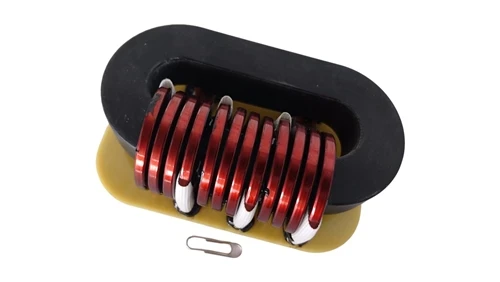
At first glance, the overall dimensions of this common mode choke are remarkably compact (especially when viewed next to a standard paperclip for scale). However, within this micro-spec footprint lies an integration of top-tier manufacturing processes and materials science:
A. Dual-Material Customizable Cores
The green-coated toroidal core serves as the heart of the inductor. To address different frequency bands and cost targets, it supports two distinct core material options:
Nanocrystalline Cores: Featuring an ultra-high initial permeability (μi ≥ 50,000). Its core advantage is the ability to deliver massive inductance values in an extremely small physical volume. Combined with high saturation magnetic flux density and exceptionally low high-frequency core losses, it is the premier choice for premium fast chargers and high-power-density modules.
Mn-Zn Ferrite Cores: The highly cost-effective economic variant. It exhibits outstanding noise suppression capabilities across traditional frequency bands from 10kHz to 1MHz, making it ideal for standard devices with low-to-medium power and low peak currents.
B. Symmetrical Counter-Wound Windings
The red enameled copper wires are wound onto the toroidal core using a strict symmetrical, two-group counter-winding process. This precise winding technique is crucial to ensuring perfect electrical balance between the two coils, reducing unintended leakage inductance and differential mode insertion losses to an absolute minimum.
C. Automation-Friendly Base Design
Traditional toroidal inductors often plague automated production lines because their loose leads are difficult to locate. This component cleverly solves that problem by integrating a round, yellow epoxy base plate with sturdy through-hole (THT) metal pins at the bottom. This mechanical structure makes it fully compatible with automated plug-in machines and wave soldering processes. Complemented by full-immersion varnishing and adhesive fixing, the component boasts excellent shock, vibration, moisture, and insulation resistance.

2. Core Electrical Principles: Why Does It Filter "Selectively"?
Zero-Loss Transmission for Differential Mode (Working) Current: When the normal operating current of the device flows through the inductor, it travels in opposite directions through the two symmetrically wound coils. The magnetic fields generated inside the core cancel each other out. As a result, the inductance drops virtually to zero, passing the useful power or signal current with zero insertion loss.
Aggressive Suppression for Common Mode (EMI Noise) Current: When conducted interference or high-frequency radiation noise appears on the lines, the unwanted signals usually flow in the same direction across both lines. In this scenario, the magnetic fields generated by both coils reinforce each other. The core instantly presents a massive impedance, aggressively blocking and absorbing the high-frequency noise and eliminating the root cause of excessive radiation or conduction emissions.

3. Wide Temperature Stability: A Versatile Component Across Industries
Beyond its brilliant filtering mechanism, the product features rugged environmental adaptability. Supporting a wide operating temperature range from -40°C to +125°C, it maintains highly stable inductance parameters even under harsh industrial or automotive thermal cycling.
This reliability makes it an essential, go-to component for power-line EMC filtering across diverse sectors:
Consumer Electronics & Smart Fast Charging: USB-PD fast chargers, laptop power adapters, and optical modems-eliminating high-frequency conducted noise generated by rapid switching frequencies.
Inverter Home Appliances: Placed at the power input front-end of inverter air conditioners and induction cookers to suppress switching radiation from high-power devices like IGBTs.
EVs & Energy Storage: Auxiliary power modules within micro-inverters, automotive On-Board Chargers (OBC), and portable energy storage power supplies.
Industrial Automation & Medical Devices: Miniature servo drives, PLC power modules, sensors, and high-precision medical monitors-preventing external electromagnetic hash from causing system glitches, false triggers, or signal distortion.
In an era where every millimeter of board space counts, the integration and size of magnetic components directly dictate a final product's market competitiveness. This miniature through-hole common mode choke, with its low leakage flux, broadband high impedance, excellent wide-temperature performance, and automation-friendly architecture, delivers an ideal answer to the modern challenges of high-density switching power supply EMC design.