In the design of modern Switched-Mode Power Supplies (SMPS), smart terminals, and automotive electronics, hardware engineers face a perpetual challenge: How do you solve increasingly complex electromagnetic compatibility (EMC/EMI) issues within shrinking physical spaces?
As system integration continues to skyrocket, real estate on the PCB (Printed Circuit Board) has become incredibly premium. Today, let's take a close look at a compact yet highly efficient component-the Vertical Through-Hole Toroidal Common Mode Choke-and explore the art of noise suppression in high-density layouts.
1. Why "Vertical"? The Ultimate Pursuit of Space Optimization
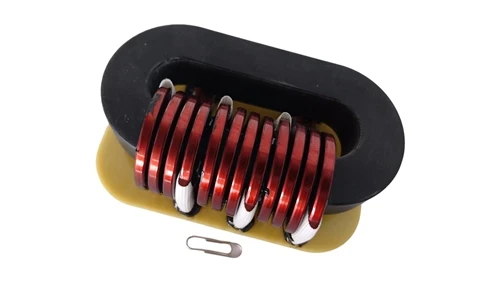
When placing this common mode choke side-by-side with a standard paperclip, its compact form factor is immediately striking.
However, its real secret weapon in practical PCB layout lies in its vertical structural design:
Horizontal Design: Traditional toroidal chokes are often mounted flat against the board. While this offers a lower profile, it consumes a massive amount of board surface area (footprint).
Vertical Design: By mounting the toroidal core perpendicular to the base and the PCB surface, this design cleverly extends space into the vertical dimension. It drastically reduces the required board footprint, freeing up vital real estate for high-density component placement-such as in high-performance AI server power supplies or automotive charging modules.

2. Materials and Structure: The Core of High-Efficiency EMI Filtering
Excellent filtering performance relies on robust material science and precise manufacturing. Looking closely at the component's structural details, we can break down its heavy-duty anatomy into a few key elements:
1. High-Permeability Manganese-Zinc (MnZn) Ferrite Core
The green ring at the center is a ferrite core coated with an insulating layer of epoxy resin. In the magnetics industry, this distinctive green coating typically signifies a Manganese-Zinc (MnZn) material optimized for high permeability. The toroidal geometry provides a fully closed magnetic circuit, which translates to exceptional magnetic efficiency and minimal magnetic leakage-preventing secondary interference with nearby sensitive signal lines.
2. Symmetrical Double-Wire Winding
When viewed from above, two independent lines of enameled copper wire are wrapped around the core in perfect symmetry. When common-mode noise (signals traveling in the same direction) enters the choke, the magnetic fluxes generated by the two coils add up within the core. This creates a massive impedance that blocks and dissipates the interference like a solid wall. Conversely, for the essential differential-mode current (working current), the opposing fluxes cancel each other out, allowing the signal to pass through with virtually zero attenuation.
3. Through-Hole Pins & High-Temperature Resistant Base
The black engineered plastic base provides excellent electrical insulation and mechanical support for the windings. Extending from underneath are four through-hole metal pins designed for rugged environments. Unlike Surface Mount Devices (SMD), through-hole (DIP) components are anchored securely into the PCB vias via wave or manual soldering. This delivers superior mechanical strength and vibration resistance, ensuring flawless stability in high-vibration applications like automotive environments.

3. Typical Application Scenarios
Thanks to its balanced blend of a small footprint, strong noise suppression, and robust mechanical stability, the vertical through-hole toroidal common mode choke plays a critical role in sectors with uncompromising EMC requirements:
Consumer Electronics Power Supplies: Used in smartphone fast chargers and laptop power adapters to suppress input-side EMI noise caused by switching transients and high-frequency oscillations.
Industrial & Data Center Power Supplies: Serves as a critical filtering element in high-density power modules for AI servers and industrial inverters.
Automotive Electronic Systems: Acts as an essential electromagnetic firewall in precision automotive control boards and infotainment systems, helping hardware pass stringent automotive EMC tests like CISPR 25.
4. Conclusion: Small Size, Massive Impact
Great hardware design is always about finding the sweet spot between space, cost, and performance. The vertical through-hole toroidal common mode choke proves that by combining structural innovation (vertical mounting) with a time-tested closed magnetic circuit (toroidal geometry), a tiny component can deliver immense noise-suppression energy.