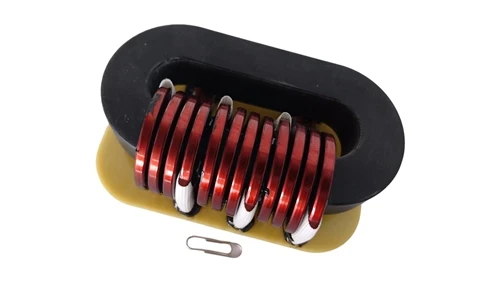
In the realm of power electronics design, Magnetic Saturation is a persistent "nightmare" for every engineer. As the demand for Power Density in AI data centers and EV charging stations rises to near-frenetic levels, traditional inductor designs are facing severe challenges at their physical limits.
The current industry pain point lies in traditional Ferrite cores: while they offer extremely low loss, their saturation curve is incredibly steep. Once the operating current exceeds a critical threshold, the inductance collapses instantaneously-a phenomenon known as Hard Saturation. This leads to uncontrollable current slew rates (di/dt), which can, at best, trigger protective system resets or, at worst, lead to the catastrophic breakdown of expensive MOSFETs.
Can we design an inductor that maintains high efficiency while achieving a "graceful landing" during overloads? Magsonder's patent, US 11,430,597 B2, provides a disruptive "hybrid" solution.
The Innovation
Magsonder's core breakthrough lies in breaking the conventional mindset that a magnetic core must consist of a single material, proposing an Asymmetric Hybrid Magnetic Circuit design.
The logic of this innovation is based on "functional zoning" of two materials with vastly different physical properties:
High-Saturation Middle Column: At the center of the core where stress is most concentrated, a metal powder material with Soft Saturation characteristics is used. It acts as the "anchor" for power handling, ensuring the magnetic circuit does not fail instantaneously under high current surges.
High-Permeability Periphery (Yoke & Side Columns): For the yoke and side columns responsible for closing the magnetic loop, high-permeability Ferrite or amorphous materials are used. These act as "magnetic flux highways," ensuring high efficiency at normal operating frequencies through extremely low Reluctance.
This asymmetric layout endows the inductor with the dual DNA of "efficiency" and "resilience," achieving a true leap in performance.

How It Works
The Magsonder patent is not a simple stacking of materials; it achieves "staircase management" of Magnetic Flux through a precision-engineered physical structure. Below are the three technical pillars of its internal operation:
1. Deeply Nested "Magnetic Buffer" Structure
The patent introduces a critical geometric constraint: d/D≥(B1−B2)/B1.Where d is the depth to which the metal powder middle column is inserted into the ferrite yoke. This design ensures that the magnetic flux is effectively diffused at the interface before entering regions of lower permeability. This Stepped Nesting eliminates flux congestion at material boundaries, preventing localized hotspots caused by premature saturation.
2. Multi-path Parallel "Flux Distribution"
By utilizing at least two high-permeability (Permeability ≥ 200) side columns, Magsonder upgrades the magnetic circuit from a single loop to a multi-path parallel system. This design significantly reduces the overall reluctance of the core, not only improving inductance stability across a wide current range but also substantially reducing the winding's DCR (DC Resistance).
3. Dynamically Responsive "Performance Gradient"
Normal Load: Magnetic flux primarily flows through the high-permeability ferrite path, resulting in minimal core loss and peak conversion efficiency.
Transient Overload: When current surges cause the ferrite to approach saturation, the metal powder middle column takes over the excess energy due to its high Bsat (Saturation Flux Density). This "staircase relay" stretches the cliff-like inductance drop into a smooth, downward-sloping curve, gaining precious microseconds of response time for the control loop.

Use Cases
Magsonder's patented technology has demonstrated exceptional Architecture advantages across several core application scenarios:
AI Data Center Power Supplies (Server PSUs): During violent Transient Load Steps in GPU workloads, the asymmetric magnetic circuit provides necessary inductance redundancy, maintaining the stability of the power regulation system and preventing computational interruptions.
EV On-Board Chargers (OBC): In 800V high-voltage platforms, this technology effectively handles instantaneous surges from grid fluctuations, ensuring the OBC does not shut down due to saturation and enhancing the Robustness of the charging process.
Interleaved Parallel PFC Circuits: Leveraging the high permeability of the side columns, it reduces mutual inductive coupling between multi-phase inductors, simplifying control algorithms and optimizing volume to achieve higher power output in a smaller footprint.
Future Outlook
With the proliferation of Wide Bandgap semiconductors (such as SiC, GaN), increasing switching frequencies demand higher Scalability from magnetic components. Magsonder's asymmetric magnetic circuit technology not only solves the saturation dilemma at physical limits but also clears the path for the miniaturization and Low Profile design of magnetic elements.
It marks the beginning of the evolution of power inductors from simple "passive components" to "complex magnetic circuit management solutions." In the future, this methodology based on physical property gradient design will become the underlying cornerstone for building Smart Power Systems.
The art of magnetic balance lies in the precise guidance of energy. Through asymmetric hybrid magnetic circuit innovation, Magsonder ensures that power systems remain resilient even in the face of extreme challenges.