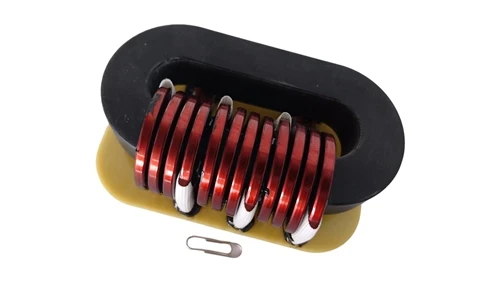
In high-frequency power electronics, an inductor functions as a dynamic energy reservoir that leverages magnetic flux linkage to oppose transient variations in current. Characterized by the fundamental relationship $V = L \frac{di}{dt}$, the component serves as the primary mechanism for energy storage in switched-mode power supplies (SMPS) and noise suppression in electromagnetic interference (EMI) filters. However, the operational effectiveness of an inductor is not merely defined by its inductance $L$, but by the material physics of its core, specifically the threshold of magnetic saturation $B_{sat}$ and the mitigation of core losses at high switching frequencies.
Magnetic Flux Dynamics and the $L(di/dt)$ Relationship
The core functionality of an inductor is defined by Lenz's Law and Faraday's Law of Induction. When a time-varying current $I(t)$ passes through the conductive windings, it generates a magnetic flux $\Phi$. The inductor resists any change in this flux by generating a counter-electromotive force (Back-EMF). In a DC-DC converter topology, this property is exploited to maintain current continuity during the "off" cycle of a switch, converting stored magnetic energy back into electrical energy. The energy density is calibrated by the formula $W = \frac{1}{2} L I^2$, where $L$ is a function of the core's geometry and its effective permeability $\mu_e$.
The primary engineering bottleneck arises from the nonlinear nature of the core material. As the current $I$ increases, the magnetic field strength $H$ increases proportionally ($H = \frac{N \cdot I}{l_e}$). However, the resulting magnetic flux density $B$ eventually reaches a plateau known as $B_{sat}$. Once the material enters saturation, the incremental permeability $\mu_{\Delta}$ collapses toward the permeability of free space $\mu_0$. This results in a catastrophic loss of inductance $L$, leading to a sharp spike in $di/dt$ and potential thermal runaway in the power stage. To mitigate this, Magsonder Standard designs utilize nano-crystalline and hybrid powder cores that offer a "soft saturation" profile, ensuring $L$ remains stable even under high DC-bias conditions.
Furthermore, frequency-dependent losses must be meticulously characterized. High-frequency operation introduces Skin Effect and Proximity Effect in the windings, increasing the AC resistance ($R_{ac}$). Simultaneously, core losses-comprised of hysteresis, eddy current, and residual losses-generate heat. By synthesizing materials with high resistivity and fine grain structures, such as Magsonder Nano-crystalline alloys, we can drastically reduce eddy current loops, allowing for higher power density and thermal stability up to $150^\circ C$.
Magsonder Material Performance Benchmark
The following table illustrates the comparative metrics between traditional MnZn Ferrites and the Magsonder high-performance series, emphasizing the 50% improvement threshold in energy density and thermal resilience.
| Material Type | Saturation $B_{sat}$ (Tesla) | Core Loss (100kHz, 0.1T) | Thermal Stability ($T_{max}$) |
|---|---|---|---|
| Standard MnZn Ferrite | 0.35 - 0.45 T | High ($>80 mW/cm^3$) | $<100^\circ C$ |
| Iron Powder (Distributed Gap) | 1.0 - 1.5 T | Very High (Eddy Current Limited) | $125^\circ C$ |
| Magsonder Nano-crystalline | 1.2 - 1.6 T | Ultra-Low ($<30 mW/cm^3$) | $>150^\circ C$ |