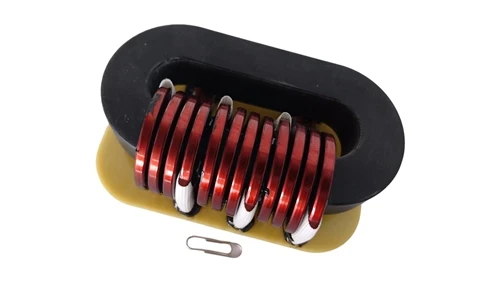
In the realm of power electronics design, magnetic saturation is one of the most persistent "nightmares" for engineers. Traditional Ferrite inductors, while offering extremely low loss, exhibit a very abrupt saturation characteristic. Once the current exceeds a critical threshold, the inductance collapses instantaneously-a phenomenon known as Hard Saturation. This "cliff-like" drop leads to uncontrollable current slew rates (di/dt), which can, at best, trigger system resets or, at worst, lead to the catastrophic breakdown of expensive MOSFET power devices.
Faced with the challenge of increasing power density, can we design an inductive system that maintains high efficiency while achieving a "graceful landing" during overloads? Magsonder's patent, US 11,430,597 B2, provides a groundbreaking solution.
The Innovation
Magsonder's core breakthrough lies in breaking the conventional mindset that a magnetic core must consist of a single material. Instead, they proposed the Asymmetric Hybrid Magnetic Circuit design.
This patent utilizes a scientifically optimized ratio to combine two materials with vastly different physical properties:
High-Saturation Middle Column: Utilizes metal powder materials with Soft Saturation characteristics to act as the "anchor" for power handling.
High-Permeability Yoke & Side Columns: Employs high-permeability Ferrite or amorphous materials to construct a "magnetic flux highway" with extremely low magnetic resistance (reluctance).
This asymmetric material combination allows the inductor to achieve high efficiency during normal operation while exhibiting a gentle, gradual decline in inductance under extreme current conditions.

How It Works
The Magsonder patented technology is not a simple stacking of materials; it achieves "staircase management" of magnetic flux through a precision-engineered physical structure:
Stepped Nesting: The middle column is not merely placed against the surface of the yoke; it is inserted into the yoke at a specific depth d. By following the rigorous mathematical formula d/D ≥ (B1 - B2) / B1, the design ensures that magnetic flux is effectively diffused at the interface before entering regions with lower saturation points.
Flux Dispersion: By utilizing at least two side columns with high magnetic permeability (μ ≥ 200), the magnetic circuit is upgraded from a single channel to a multi-path parallel system.
Gradient Control: A performance gradient is formed by leveraging the high Bsat (saturation flux density) of the middle column and the low magnetic loss of the yoke. When current surges, even if the yoke tends toward saturation, the middle column maintains magnetic support. This transforms the "cliff-like" inductance drop into a smooth, downward-sloping curve.

Use Cases
EV On-Board Chargers (OBC): In 800V high-voltage platforms, this technology handles instantaneous surge currents from grid fluctuations, ensuring the OBC does not shut down due to inductor saturation.
AI Data Center Power Supplies (Server PSUs): During violent transient load jumps from GPUs, the asymmetric magnetic circuit provides the necessary inductance redundancy. This maintains the stability of the power regulation architecture and prevents computational interruptions caused by current overloads.
Future Outlook
With the proliferation of Wide Bandgap (WBG) semiconductors (such as SiC and GaN), increasing switching frequencies demand higher scalability from magnetic components. Magsonder's asymmetric magnetic circuit technology not only solves the saturation dilemma at physical limits but also clears the path for the miniaturization and low-profile design of magnetic elements. It marks the evolution of power inductors from "passive components" to "intelligent magnetic circuit management."
The art of magnetic balance lies in the precise guidance of energy. Through asymmetric magnetic circuit innovation, Magsonder ensures that power systems remain resilient even under extreme operating conditions.