Invisible Heat, Visible Risks
In modern power electronics design, as the demand for power density in New Energy Vehicles (NEVs), PV inverters, and AI server power supplies continues to climb, engineers face a common nemesis: Heat. For High-Power Inductors, current signifies not just the transmission of energy, but the accumulation of heat.
In Magsonder's R&D philosophy, we believe in one rule: The nominal parameters on the datasheet are just the starting line; actual performance in extreme environments is the finish line.
Many magnetic component suppliers only provide data based on theoretical calculations. However, at Magsonder, we insist that "Testing is King." Recently, our laboratory conducted a rigorous Temperature Rise Test on a customized Magsonder high-frequency, high-current inductor.
This article takes you inside the Magsonder testing lab. Through a set of real 60A high-current test data, we reveal how we use extreme testing to ensure the absolute safety and reliability of every component that leaves our factory.
The Scenario: When Current Hits 60 Amps
In Magsonder's latest test video, we demonstrated a typical "Thermal Equilibrium" test scenario. This is a precise game of current, resistance, and thermodynamics.
1. Magsonder Standardized Test Environment
To obtain the most accurate data, Magsonder engineers built a test link that meets industrial standards:
Excitation Source: A high-precision, high-power DC power supply capable of continuously outputting stable high current with low ripple.
Monitoring: A multi-channel Data Logger combined with high-sensitivity Type-K Thermocouples, directly attached to the coil's Hot Spot.
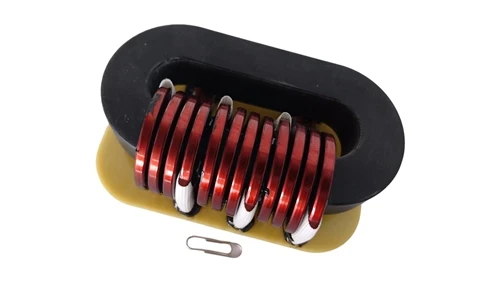
Device Under Test (DUT): A Magsonder self-developed high-power magnetically shielded inductor sample.
2. Key Data Snapshot
When the test reached the thermal stability stage, our instruments captured the following core data:
DC Current: 60.01 A
Stabilized Temp: 121.6°C
Ambient Temp: 25°C
This data reveals a fundamental law of physics: When a massive current of 60 Amps flows through the inductor coil, Joule heating generated by Copper Loss causes the inductor's surface temperature to rise by approximately 96°C above room temperature. At this point, the temperature curve flattens, reaching a state of thermal equilibrium.

Why We Obsess Over Temperature Rise
Many customers often only focus on Inductance (L) and Saturation Current when selecting parts, easily overlooking the Temperature Rise Current. However, in Magsonder's technical system, the importance of temperature rise testing is equal to that of inductance testing because it is the "weakest link" determining system lifespan.
1. The Challenge of Insulation Lifespan
An inductor consists of copper wire, insulating varnish, a magnetic core, and a bobbin. Each material has its Thermal Class limit.
In the test above, the measured data of 121°C conveyed critical information to Magsonder engineers:
Safety Margin Verification: This series of Magsonder products uses Class F (155°C) or Class H (180°C) insulation materials. Even reaching 121°C under a full 60A load, we still retain a safety margin of 30°C~60°C.
Rejecting "Borderline" Designs: If ordinary Class B (130°C) materials were used, 121°C would be a dangerously close edge. Long-term operation would lead to insulation aging, peeling, and ultimately inter-turn short circuits. Magsonder refuses to take such low-cost risks.
2. Preventing Core "Thermal Runaway"
The magnetic permeability of ferrite or alloy powder cores changes with temperature. If the temperature rise is too high and approaches the core's Curie Temperature, the inductance will drop sharply (Roll-off), causing circuit filtering failure or even burning out downstream MOS tubes. Through 60A real-world testing, Magsonder ensures the core continues to work in its optimal linear region at high temperatures without risk of magnetic saturation.
The Magsonder Standard: Beyond Basic Compliance
Many general standards on the market define temperature rise current as "the current at which temperature rises by 40°C." However, in heavy industry, energy storage, or fast-charging applications involving hundreds of amperes, this is often too conservative or impractical.
At Magsonder, we push testing standards to a combat-ready level:
Extreme Condition Simulation: We do not do "superficial" testing. As seen, the Magsonder lab applies 60A or even higher currents to simulate the real state of customer products under full load or overload.
Long-term Burn-in: The 121°C seen in the video is not an instantaneous peak, but a "steady-state value" after hours of power-on time when the temperature no longer rises. This requires great patience, but it is the only way to rule out "early failures".
Multi-dimensional Thermal Analysis: In addition to contact measurement via thermocouples, Magsonder combines infrared thermal imaging technology to scan for local "Hot Spots" inside the coil, ensuring uniform heat dissipation.

The Technology Behind the Data
Controlling temperature rise within a reasonable range under high current is no easy feat. It is the result of Magsonder's deep accumulation in materials science and structural design:
Flat Wire Technology: Compared to traditional round wire, Magsonder extensively uses flat copper wire wound edgewise. This not only greatly increases the effective cross-sectional area of the conductor, reducing DC Resistance (DCR), but also utilizes the larger surface area to improve heat dissipation efficiency, significantly lowering the impact of the Skin Effect.
Low-Loss Magnetic Powder: Magsonder's core materials undergo special formulation to maintain extremely low Core Loss even at high temperatures, avoiding the vicious cycle of "Current Heat + Core Heat".
Molding & Thermal Path: Excellent structural design builds an efficient heat conduction path, quickly exporting core heat to the outer shell or heat dissipation substrate.
Powering Safety and Reliability
When you see a perfect waveform on an oscilloscope, or experience superior stability during the long-term operation of equipment, remember that this is supported by countless extreme tests like this "60A, 121°C" run in the Magsonder laboratory.
The black inductor working silently in the video is not just an electronic component; it is a solemn promise from Magsonder regarding quality, safety, and performance.
If you are looking for high-reliability magnetic component solutions for high-current applications, welcome to contact the Magsonder technical team. We provide not only products but also data support verified by fire and gold.