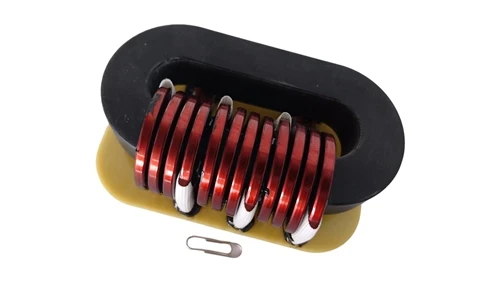
In today's explosion of AI and cloud computing, the pursuit of energy efficiency in data centers has become nearly exacting. To achieve 80 PLUS Titanium efficiency, power supply systems must maintain extremely high conversion efficiency across the entire load range, from 10% to 100%. However, in high-frequency and high-current scenarios, traditional inductors are often limited by Core Loss and Leakage Flux, acting as the "invisible killers" that prevent efficiency from crossing the final 1% threshold. How can we break through the performance bottleneck of traditional Power Factor Correction (PFC) circuits through fundamental innovation in magnetic components? A core patent from Magsonder provides the answer.
The Innovation
Magsonder's patent US 11,430,597 B2 proposes an innovative Hybrid Magnetic Circuit Architecture. The essence of this technology lies in abandoning single-material designs in favor of a physical combination of materials with different magnetic properties, achieving a Pareto-optimal magnetic field performance:
Heterogeneous Material Combination: The system utilizes metal powder (such as FeSiAl or silicon steel powder) with High Saturation Magnetic Flux Density for the Middle Column that carries the main flux, ensuring no saturation occurs under heavy currents.
High-Permeability Side Columns: At least two side columns with a magnetic permeability of μ ≥ 200 are introduced to the outer sides of the yokes.
Amorphous Application: The side columns can utilize amorphous or nanocrystalline materials with permeability exceeding 5000. Their extremely low coercivity and high-permeability characteristics provide a "highway" for magnetic flux recovery.

How It Works
Through precise geometric design and magnetic circuit allocation, this architecture reshapes the internal operational logic of the inductor:
Precise Guidance of the Magnetic Circuit: In traditional structures, yokes often face the risk of Local Saturation due to uneven flux distribution. Magsonder's design inserts the middle column into the yoke and strictly limits the Insertion Depth Ratio to satisfy: d / D ≥ (B1 - B2) / B1. This structure forces the magnetic flux to transition smoothly from the high-saturation middle column to the high-permeability yoke, avoiding abrupt transition losses at the circuit interface.
Magnetic Circuit Closure and Leakage Suppression: The high-permeability side columns and the upper/lower yokes form a closed, low-reluctance loop. This acts like a "magnetic shield wall" around the inductor, re-absorbing leakage flux that would otherwise dissipate into the air back into the circuit.
Multi-phase Decoupling Mechanism: In Interleaved topologies, high-permeability side columns effectively reduce the Coupling Coefficient between the two-phase inductors. This allows each phase of the PFC inductor to operate independently and stably, simplifying the complexity of control algorithms.

Use Cases
1. Ultra-High Density Titanium-Grade Server Power Supplies (CRPS)
In power supplies meeting the 80 PLUS Titanium standard, this technology is used for interleaved PFC boost inductors. By using amorphous side columns, the system's Standby Loss at light loads is significantly reduced. Meanwhile, under medium-to-high loads, the anti-saturation characteristics of the metal powder middle column maintain inductance linearity, helping the system reach peak efficiencies of over 96%.
2. Modular High-Power Solar Inverters
In solar boost circuits, inductors typically face high temperatures and large current fluctuations. Magsonder's patented structure utilizes an integrated shell and Glue Filling process to rapidly export heat generated by the high-permeability side columns, enhancing thermal stability. Additionally, the compact structure saves approximately 25% of board space compared to traditional toroidal inductors.
Future Outlook
As third-generation semiconductors like Gallium Nitride (GaN) and Silicon Carbide (SiC) push switching frequencies into the MHz range, a "material revolution" in magnetic components is inevitable. Magsonder's approach of Modular Magnetic Integration based on high-permeability side columns will drive the evolution of magnetic components from simple energy storage units toward "magnetic subsystems" featuring high functional integration, self-shielding properties, and thermal management advantages. This is not just an efficiency boost, but a fundamental cornerstone for the low-carbon operation of future green computing infrastructure.
Magsonder's high-permeability side column technology not only breaks the physical limits of materials but also provides the core momentum for the leap in Titanium-grade power performance. Stay tuned to the Magsonder Technical Column as we explore the vast frontier of magnetic technology together.