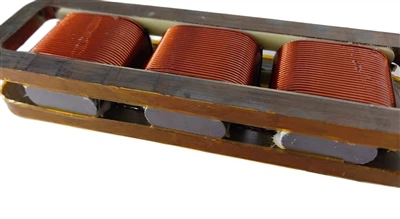
In the field of power electronics, we often say "the devil is in the details." In inductor design, however, it is often a single overlooked parameter that dictates the stability and efficiency of the entire power system. Have you ever encountered this: despite using high-saturation metal powder cores for the middle column, your interleaved circuits still suffer from severe electromagnetic interference (EMI), unstable coupling coefficients, or light-load efficiencies far below expectations? Many junior engineers focus solely on the saturation characteristics of the middle column while ignoring the critical "supporting actor" in the closed magnetic circuit-the Side Column.
Today, we will deconstruct the core parameter settings of Magsonder's patent to reveal why the magnetic permeability(μ) of the side columns must absolutely not be lower than 200.
The Innovation
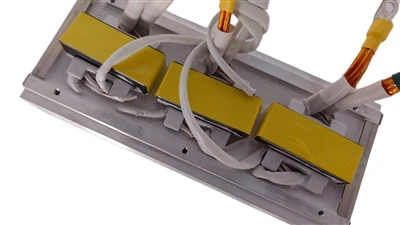
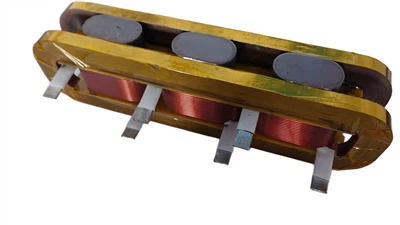
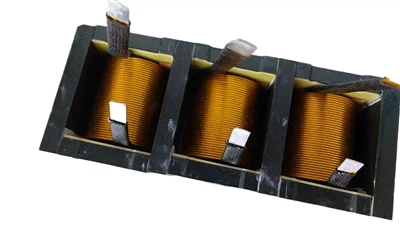
Magsonder's patent US 11,430,597 B2 proposes a groundbreaking Hybrid-Material Core Architecture. Its core innovation lies not in the mere stacking of materials, but in the precise allocation of material properties across different positions within the magnetic circuit:
Decoupling of Heterogeneous Materials: The patent breaks the traditional "one-material-fits-all" logic. It specifies that the middle column should use high-saturation, low-permeability metal powder, while the side columns and upper/lower yokes must utilize high-permeability materials.
The Critical Threshold (μ ≥ 200): The patent clearly defines a lower limit of 200 for the side column permeability. This is a physical threshold derived from rigorous magnetic circuit simulations, ensuring the side columns act effectively as "flux guides."
Low Reluctance Path: By using Ferrite or Amorphous Materials for the side columns, a path is artificially created with a reluctance far lower than that of air, thereby achieving absolute control over the magnetic field.

How It Works
To understand the vital importance of μ ≥ 200; we must analyze the logic of this magnetic architecture:
"Selective" Flow of Magnetic Flux Magnetic flux always tends to follow the path of least reluctance. When the permeability of the side column (μ) is greater than 200, it creates a massive reluctance differential compared to air (μ = 1). Consequently, flux generated in the middle column prioritizes closing through the yokes and side columns rather than dissipating into the air.
Suppression of Flux Leakage If the side column permeability is too low (e.g., below 100), it cannot effectively confine the flux. Significant fringing flux will escape into the inductor windings or surrounding PCB traces. This not only causes a spike in AC loss but also triggers system-level EMI issues. The patented side column acts as an "electromagnetic barrier," locking magnetic energy within the intended rails.
Stabilizing the Coupling Coefficient In interleaved topologies, two inductors are usually placed in close proximity. By setting side columns with μ ≥ 200;, the patent reduces mutual induction between adjacent cores. This ensures each phase of the inductor remains highly independent, preventing current distribution imbalances caused by magnetic crosstalk.

Use Cases
Case 1: High-Performance Server PSUs For power modules aiming for 80 PLUS Titanium efficiency, high light-load efficiency is critical. Magsonder's technology utilizes the extremely low coercivity of amorphous materials (μ > 5000) to significantly reduce hysteresis loss. At light loads, standby losses can be reduced by more than 15% compared to standard powder core solutions.
Case 2: High-Power Automotive OBC and DC-DC EV powertrain environments are extremely complex with strict EMC requirements. Magsonder's structure achieves a "self-shielding" effect via the high-permeability side columns. In real-world applications, this reduces shielding costs and enhances mechanical reliability under vibration through an integrated glue-filling process.
Future Outlook
With the rise of Wide Bandgap (WBG) semiconductors like Silicon Carbide (SiC), switching frequencies are pushing toward 500kHz and beyond. At high frequencies, skin and proximity effects caused by leakage flux grow exponentially. Magsonderμ ≥ 200; logic provides a standardized template for magnetic integration. We foresee that this combination of heterogeneous materials, defined by precise parameter boundaries, will become the industry standard for high-power-density inductors.
The permeability of the side column is not an arbitrary value-it is the lifeline that maintains magnetic circuit closure and system efficiency. Stay tuned to the Magsonder Technical Column for more deep dives into the underlying logic of magnetic components.