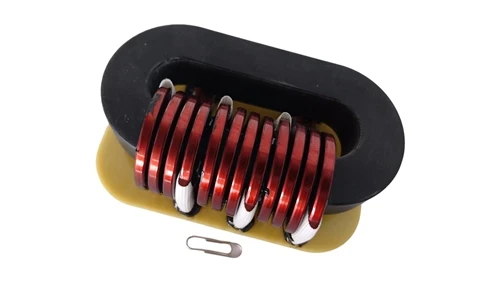
In today's pursuit of ultra-high power density, power electronics engineers often face an "impossible trinity": high performance, compact size, and high reliability. When handling high-current and high-frequency scenarios, traditional inductor designs often suffer from efficiency drops or acoustic noise under heavy loads, primarily due to magnetic saturation from single-material limitations or insufficient mechanical strength. How can we ensure long-term stability in harsh industrial environments while maintaining extreme magnetic characteristics? A core patent from Magsonder provides a forward-looking architectural reference.
The Innovation
The core of Magsonder's patent lies in breaking the limitations of single magnetic materials by adopting a Hybrid Magnetic Circuit architecture.
This design ingeniously utilizes a Metal Powder Core with high saturation magnetic flux density as the middle column, complemented by yokes and side columns with high magnetic permeability. The key innovations include:
Application of Amorphous Side Columns: The side columns utilize amorphous lamination materials with a magnetic permeability higher than 5000.
Plug-in Coupling Structure: The middle column is not simply attached but is embedded into the yokes at a specific insertion depth ratio: d / D ≥ (B1 - B2) / B1. This thoroughly solves the industry's chronic issue of premature saturation at the interface of ferrite yokes.

How It Works
The operational logic of this architecture can be broken down into three levels:
Flux Shunting and Path Optimization: The middle column carries the main magnetic flux, leveraging the high saturation characteristics of metal powder to handle large currents. Meanwhile, the side columns with high magnetic permeability (μ ≥ 200) provide a closed path with extremely low magnetic reluctance. This "shunting" mechanism not only reduces overall magnetic loss but also significantly suppresses leakage flux.
Geometric Symmetry and Stress Distribution: In the patent, the side columns are symmetrically distributed around the middle column. This physical symmetry ensures a uniform magnetic field distribution, reduces the generation of localized hotspots, and enhances the balance of the mechanical structure.
Integrated Packaging Process: To firmly bond these heterogeneous materials, Magsonder designed a specialized outer shell and integrated glue-filling process. By filling slots reserved in the side walls of the shell with specialized adhesive, the internal components are bonded into a single unit to improve shock resistance. Furthermore, the thermal conductivity of the glue enhances heat dissipation and effectively absorbs high-frequency whistling caused by magnetostriction.

1: Data Center Titanium-Grade Server Power Supplies (CRPS)
In power supplies striving for 80 PLUS Titanium efficiency, every milliwatt of loss is critical. Compared to traditional toroidal FeSiAl inductors, Magsonder's amorphous side column solution significantly reduces core loss under the same specifications, helping the system easily achieve high-efficiency targets at both light and full loads.
2: New Energy Vehicle On-Board Chargers (OBC)
OBCs are extremely sensitive to space. Through the plug-in design described in the patent, Magsonder can achieve a 30% volume reduction by decreasing the coil winding radius without increasing the height. Simultaneously, the glue-filling process ensures physical reliability in high-vibration automotive environments.
Future Outlook
As Wide Bandgap (WBG) semiconductors like SiC and GaN become prevalent, system frequencies are moving toward the MHz level. Traditional magnetic components have become the bottleneck limiting system performance. Magsonder's "Magnetic Lego" thinking, based on heterogeneous material combinations, points the way for future high-frequency, modular magnetic component design. This architecture not only enhances individual performance but also provides low-coupling, high-efficiency underlying support for multi-phase interleaved PFC topologies through magnetic integration.