An Engineering-Driven Evaluation for Modern Power Designs
1. Introduction
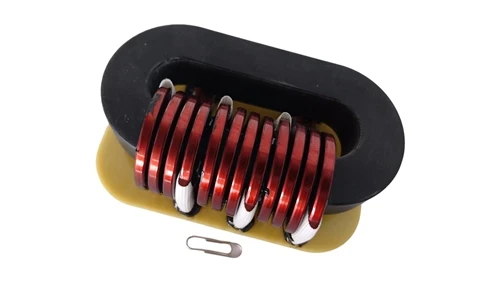
Power electronics has undergone a rapid shift toward higher current density, elevated switching frequencies, and tighter thermal envelopes. As inductors become increasingly critical to system efficiency and reliability, the geometry and material composition of their windings have evolved. Flat conductors-typically copper strips, foils, or shaped windings-have moved into mainstream use in server power supplies, automotive traction electronics, and industrial converters. Their geometry provides electrical and thermal advantages compared with traditional round wire.
With this shift, interest has grown in alternative conductor materials such as copper-clad aluminum (CCA). Although CCA has long been present in round-wire applications, its role within flat-winding inductor designs raises new engineering considerations. Material properties, mechanical behavior, thermal transport, and electrical performance differ significantly between pure copper and CCA-differences that are amplified when the conductor is processed into a flat profile.
This article examines both materials from an engineering perspective, focusing on the technical trade-offs rather than price-driven narratives. The goal is to help design engineers understand why both materials may appear in manufacturing environments and how each aligns with different performance expectations.
2. The Role of Flat Conductors in Inductors
Flat conductors address several constraints inherent in modern high-current designs:
Higher packing efficiency: Rectangular cross-sections improve fill factor and reduce DCR.
Enhanced heat spreading: More surface area and defined contact planes improve thermal coupling to cores or heat paths.
Predictable AC behavior: Conductor thickness can be selected relative to skin depth to manage high-frequency losses.
Structural stability: Flat geometries exhibit lower mechanical deformation under thermal cycling or high electromagnetic force.
As power stages migrate toward low-voltage, high-current topologies-such as 48 V to sub-1 V AI accelerator power rails-the current through each inductor phase becomes substantial. This places significant emphasis on the conductor's material properties, including conductivity, thermal transport, and long-term reliability.
CCA enters this landscape with a distinct set of characteristics, and the engineering trade-offs differ from those seen in round-wire applications.
3. Material Fundamentals: Copper and CCA
3.1 Pure Copper
Pure copper remains the reference material for electrical conductors due to:
Low resistivity and predictable conduction behavior
High thermal conductivity, enabling rapid heat dissipation
Mechanical ductility, facilitating forming and winding
Established reliability data, validated across decades of applications
For flat-winding inductors, these characteristics translate into stable losses, consistent thermal behavior, and broad process margins during manufacturing.
3.2 Copper-Clad Aluminum (CCA)
CCA is a bimetal conductor consisting of an aluminum core metallurgically bonded to a copper surface layer. Its key characteristics include:
Lower density, reducing conductor mass by 40–50%
Higher resistivity, increasing DC losses for equivalent geometry
Lower thermal conductivity, affecting heat spreading
Reduced mechanical toughness, especially under bending or cycling
CCA was originally developed for applications where cost and weight were dominant constraints-typically consumer cabling or low-to-moderate power devices. When applied to flat windings, its performance envelope differs from that of round-wire variants, and both thermal and mechanical considerations become more critical.

4. Observable Differences in Flat Conductors
In practice, flat CCA conductors often exhibit a visually uniform and highly reflective copper surface resulting from the polished cladding layer. Pure copper typically has a deeper, more natural copper tone, with subtle textural variations influenced by rolling, annealing, or bending.
These visual differences do not dictate performance, but they often prompt engineers to assess whether a conductor is pure copper or a composite-an important distinction given their divergent electrical and thermal characteristics.
5. Electrical Performance
5.1 DC Resistance
If two flat conductors share identical outer dimensions, the effective DC resistance differs:
Copper exhibits lower DCR with minimal variation over temperature.
CCA exhibits higher resistance, as DC current penetrates into the aluminum core.
This difference directly affects conduction loss and temperature rise. In high-current inductors-such as CPU/GPU VRMs or traction inverters-DCR often determines overall thermal feasibility. In these settings, even small increases in resistance have system-level consequences.
5.2 AC Losses and Skin Depth
At elevated frequencies, skin effect limits penetration depth into the conductor. The copper layer in CCA carries a disproportionate share of the AC current, which can partially mitigate the higher DC resistance.
However, flat inductors are typically engineered with a thickness close to one or two skin depths at the target switching frequency. When thickness is actively optimized, pure copper offers simpler and more predictable high-frequency performance without the complexity of multilayer conduction paths.
6. Thermal Performance and Reliability
Thermal behavior is one of the most decisive factors in selecting conductor materials for inductors.
Pure copper's high thermal conductivity allows heat generated in the winding to spread uniformly into the core or heat dissipation structures. This reduces hotspot formation and yields predictable thermal gradients.
CCA relies on an aluminum core with significantly lower thermal conductivity. Under conditions of sustained high current, rapid power cycling, or operation in elevated ambient temperatures, thermal gradients tend to be more pronounced. Connection points-such as soldered joints, welded tabs, or press-fit interfaces-can become stress concentration regions where localized heating accelerates degradation.
For applications with strict reliability requirements or extended service life, these thermal differences cannot be ignored. Even marginal increases in temperature rise can reduce overall system lifetime or narrow operating margins.

7. Mechanical and Manufacturing Effects
Flat conductors introduce mechanical challenges that differ from round-wire winding processes. During bending, shaping, or tensioning:
Pure copper tolerates deformation with minimal risk of internal separation or micro-cracking.
CCA may experience stress accumulation at the copper–aluminum interface, particularly during repeated thermal cycling or tight-radius bending.
The metallurgical bond in CCA is robust but still represents a material interface with differing expansion coefficients and mechanical properties. If design rules are not carefully observed, delamination or fatigue may occur over time.
Manufacturing with CCA therefore requires:
Controlled winding tension
Larger minimum bending radii
Careful process monitoring to prevent deformation-induced damage
These constraints narrow the acceptable process window relative to copper.
8. Why Both Materials Appear in the Same Production Environment
The simultaneous presence of copper and CCA within a factory typically reflects intentional product segmentation rather than substitution.
Common engineering-driven reasons include:
1. Different performance classes
High-current, high-efficiency, or long-lifetime inductors generally require copper. CCA may be used in moderate-power products where thermal and reliability margins are less stringent.
2. Customer-specific requirements
Some customers prioritize efficiency, thermal headroom, or lifetime durability. Others focus on system cost or weight constraints. Material choice aligns with those priorities.
3. Cost and resource optimization
In periods of copper price volatility, CCA may be deployed selectively-provided performance targets remain achievable within design limits.
In each case, material selection reflects an engineering decision based on application intent, not simply material availability.
9. Application Implications
Copper flat conductors are typically selected for:
High-current DC-DC converters (e.g., server VRMs, automotive 48 V systems)
Data center and telecom power modules
Industrial motor drives
Environments requiring tight thermal control and high reliability
CCA flat conductors are more often applied when:
Weight reduction is a key driver
System current levels are moderate
Cost efficiency is prioritized
Thermal cycling profiles are less demanding
Clear boundaries exist, and understanding them prevents unintended performance or reliability compromises.
Pure copper and copper-clad aluminum flat conductors differ in conductivity, thermal transport, mechanical behavior, and long-term reliability. Although they may appear visually similar, their performance envelopes are distinct. In modern high-density power electronics-especially designs operating near thermal or electrical limits-these differences matter.
Copper remains the preferred material where efficiency, thermal stability, and reliability are critical. CCA can be a viable alternative in designs optimized for cost or mass reduction, provided engineering safeguards are incorporated.
Ultimately, conductor choice is determined by the application's electrical, thermal, mechanical, and lifetime requirements-not by appearance or surface finish. Aligning material selection with these system-level constraints leads to more robust and predictable inductor designs.