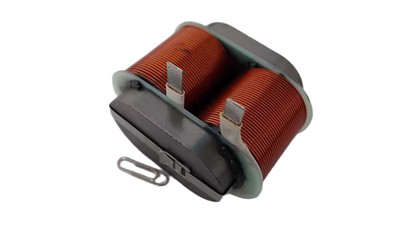
As AI server power density continues to rise, traditional air-cooling architectures are approaching their thermal limits. Liquid-cooling solutions are rapidly gaining traction in high-density GPU and ASIC clusters, offering a more effective approach to thermal management. This shift not only requires a redesign of power architectures but also imposes new challenges-and opportunities-on magnetic component development. This article examines how magnetic components must evolve through new materials, thermal-optimized structures, and liquid-compatible packaging to meet the demands of advanced liquid-cooled systems.

Rising Thermal Density in AI Servers Makes Air Cooling Insufficient
In modern AI training systems, single-server power levels have climbed from several hundred watts to 2–3 kW, while full-rack consumption can reach 60–100 kW. These increases result in far higher thermal densities than conventional data-center hardware.
As a response, liquid-cooling systems-cold-plate liquid cooling and immersion cooling-are being deployed at a growing rate, delivering higher heat-flux capacity, lower PUE, and more stable operation for dense server clusters.
This evolution in thermal architecture forces system designers to reassess all thermally critical components-especially power stages and magnetic components. For magnetics suppliers, this environment presents both engineering challenges and significant innovation potential.
A New Design Paradigm: From "Loss Reduction" to "Thermal Path Optimization + Liquid Compatibility"
In a liquid-cooled architecture, simply reducing core and copper losses is no longer adequate:
Thermal-path engineering becomes the design priority. Magnetic cores and windings must be structured to guide heat rapidly toward cold plates or coolant interfaces. Techniques include through-core apertures, embedded copper tubes as thermal bridges, and sidewall grooving to accommodate thermally conductive silicone pads for fast heat transfer.
Flattened and planar magnetic structures gain preference. Compared with traditional PQ or EE cores, planar designs offer larger contact areas with cold plates, enabling superior thermal coupling-a key benefit in liquid-cooled systems.
Materials and encapsulation require upgrades. Standard insulating varnish, plastics, and structural adhesives may swell, degrade, or delaminate when exposed to coolant. New-generation designs require corrosion-resistant materials and encapsulation methods optimized for immersion or cold-plate environments. Some suppliers are even modifying core grain boundaries with anti-corrosive oxides to enhance long-term durability.
In short, magnetic components are evolving from "electrical optimization devices" into co-engineered thermal components-working in tandem with cooling systems, power topologies, and server mechanics to achieve system-level thermal balance.
Engineering Challenges and Technical Barriers

Thermal management vs. EMI and insulation. Introducing copper tubes or thermal bridges accelerates heat transfer but also creates EMI and isolation challenges. Designers must balance thermal conductivity with magnetic isolation and EMC constraints.
Material reliability in coolant environments. Cores, encapsulants, insulation varnish, and potting materials must withstand long-term exposure to coolant, thermal cycling, and potential chemical interactions. Many materials are still undergoing extended qualification.
Increased manufacturing complexity. Flattened cores, aperture designs, and thermal-bridge structures introduce tighter process requirements. Material science, encapsulation, thermal-interface design, and mechanical precision all play critical roles in achieving consistency and reliability.
Only suppliers with combined expertise in magnetic materials, thermal engineering, liquid-compatible encapsulation, and EMC/insulation safety are positioned to deliver reliable solutions for liquid-cooled power systems.
Industry Outlook: Liquid-Cooled Magnetics Will Become the New Standard for AI Server Power
Based on feedback from magnetic-component manufacturers and power-system designers:
As liquid cooling penetrates AI servers and high-density data centers, a new generation of magnetics-planar, thermally optimized, liquid-compatible-will rapidly become mainstream.
Traditional design philosophies focused solely on loss reduction and air-cooling performance will be phased out. Future design flows will emphasize thermal path, thermal coupling, liquid compatibility, insulation integrity, and EMC safety as a unified methodology.
Suppliers capable of integrating materials, structure, packaging, and environmental qualification into a cohesive design strategy will gain a competitive edge in the next refresh cycle of AI server and high-performance power platforms.
Liquid cooling represents not merely a change in thermal technology, but a fundamental transformation in power-component design. Magnetic components must evolve from simple passive devices to thermal-critical elements engineered to support rapid heat transfer, long-term coolant exposure, and high reliability.
For power-electronics manufacturers and magnetics suppliers, the ability to balance efficiency, thermal performance, reliability, EMC compliance, and manufacturability will determine their competitiveness in the rapidly expanding AI-server and high-density data-center markets. In the coming generation of liquid-cooled architectures, magnetic components designed for thermal efficiency and environmental robustness will define the next leap forward in power-system engineering.