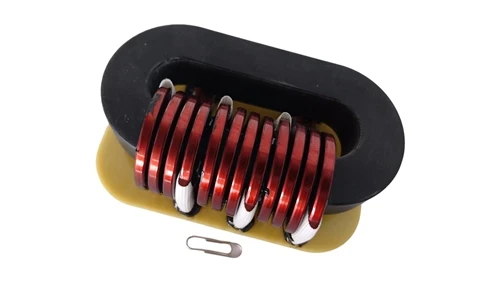
Our daily lives are inseparable from a variety of electronic devices. Open the outer shell of an electronic product and you'll find an inductor. In this article, we dissect several electronic products to explore the indispensable applications of inductors in electronic devices.
Computers, mobile phones, LCD/LED TVs/monitors, LED lights, and USB chargers all use direct current (DC), but the national power grid utilizes a 220V and 38V AC distribution system. Therefore, nearly every appliance requires an AC-to-DC or DC-to-DC (boost and buck) power supply system as either the primary or auxiliary power supply. In AC-DC and DC-DC converters, inductors are a key component, second only to the IC. Electronics engineers achieve high conversion efficiency by selecting the right inductor. Key parameters used in inductor selection include inductance value, rated current, temperature rise current, AC resistance, and DC resistance.
Below is the PCBA board of iPad2. The components circled in red are all inductors.
The picture below shows an open module of a universal power supply, in which the inductor/transformer (red part) occupies a large volume.

The figure below is a typical 1kW solar inverter anatomy diagram. The red circled parts are magnetic components such as inductors, which account for a large part of the total components.

These electric energy conversion devices have one common feature: higher and higher efficiency and smaller and smaller size. In order to achieve the goal of higher power density and smaller volume and weight, the switch tube needs to switch at a faster speed. It used to be 1-5kHz, now it is 5-30kHz, and in the future it will be 30kHz-1MHz. The higher the frequency, the smaller the inductance value required, which can reduce the volume and weight of the inductor. But at the same time, there are also great challenges to the high-frequency loss and consistency of the inductor, which requires better winding technology and core materials to convert the highest power density with the smallest volume. This also determinesThe future development trend of inductors: higher efficiency and smaller size.