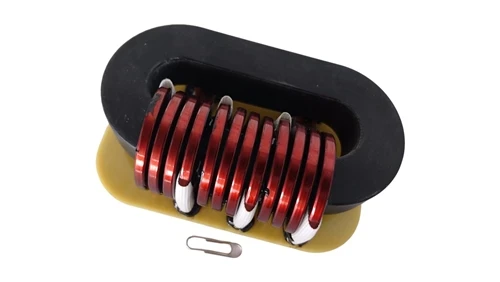
If one of the coils of a multi-wire parallel-wound magnetic toroidal PFC inductor is wound one turn less or more, testing will reveal that the temperature rise of the defective inductor is 30 to 40 degrees higher than that of a normal inductor. What is the reason for this?
The existing PFC inductor design consists of two stacked 77192 magnetic toroids and two parallel strands of F1.8mm round copper wire wound with 22 turns. Disassembly revealed that one strand had an extra turn. Testing at 50kHz revealed a normal inductance of 133μH with 22 turns and 145μH with 23 turns. However, the parallel winding yielded an inductance of 116.8μH. This phenomenon is explained below using coupled inductor and transformer models.
First, connect the two coils in series and reverse order, and then test the inductance, and you can get LMasakushiand LCross-dressing, the mutual inductance M of the two windings is 1/4 of the difference between the two, so


It can be seen that the coupling coefficient k is 0.995. For the magnetic coupling of the two coils, the voltage balance equation can be written as follows:


The above equation can be used to obtain the equivalent inductance of the two coils after decoupling, and thus calculate the current flowing through each coil.

It can be seen that the extra turn will cause a circulating current in the two coils, and the circulating current is much larger than the actual current passing through the inductor. This is the reason for the inductor heating. If the transformer model is used for analysis, the equivalent electrical parameters are shown in the figure below:


According to the voltage and current balance equations of the transformer model, the calculation is as follows:

The calculated results are the same as those obtained by the coupled inductor model. Both found that the coil with one extra turn has a reverse current, which once again confirms the cause of inductor heating.
The transformer model requires the winding ratio n, but the coupled inductor model does not have this parameter. The above derivation for the transformer model shows that even with other values of the ratio n, as long as the self-inductances L1 and L2 and the mutual inductance M remain unchanged, the results consistent with the coupled inductor model can still be obtained, indicating that the two models are completely equivalent. Interested engineers are encouraged to give it a try.