In today's modern power electronics era, power density and spatial volume control have become the ultimate metrics for evaluating technical competitiveness. Whether designing high-density AI data center CRPS power supplies, engineering 800V electric vehicle (EV) on-board chargers (OBCs), or deploying high-efficiency photovoltaic (PV) inverters, internal system space is being compressed to unprecedented limits.
As switching frequencies push into hundreds of kilohertz or even the megahertz range, magnetic component losses and thermal dissipation stand as the absolute critical bottlenecks to higher performance. Today, we dive deep into a vital component that solves these high-power challenges: The Three-Phase Toroidal Common-Mode Choke.
1. Anatomy of the Component: Heavy-Duty Design
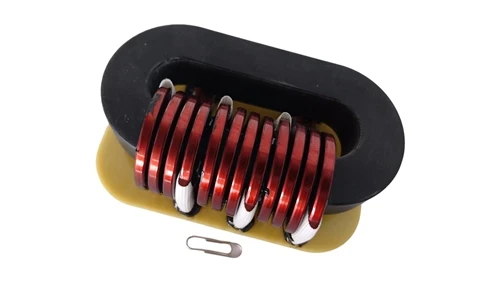
Looking closely at the three-phase common-mode choke revealed in our latest product showcase, its physical engineering speaks directly to high-power industrial demands:
Toroidal Ferrite Core: The heart of the inductor is a high-permeability toroidal ferrite core, which offers excellent high-frequency impedance properties. The outer layer is wrapped in a vibrant yellow insulation tape, ensuring premium dielectric isolation and rugged mechanical protection.
Symmetrical 3-Phase Architecture: Unlike standard single-phase chokes, this component features three sets of mathematically balanced and physically symmetrical windings. It has a 6-pin terminal configuration corresponding precisely to the input and output lines of a three-phase AC power network.
Heavy-Gauge Enameled Copper Wire: The coils are wound with exceptionally thick, high-grade enameled copper wire. This low-resistance implementation guarantees that the component can withstand massive continuous operating currents and severe transient thermal loads without degrading.

2. Fundamental Working Principles
The highly efficient operation of this three-phase common-mode inductor hinges on precise internal electromagnetic balance and flux cancellation:
A. Differential-Mode Signal Transmission
When the balanced normal working current of a three-phase system passes through, the vector sum of the operating currents equals zero:
Because the three windings are wrapped symmetrically, the magnetic fluxes generated inside the toroidal core are equal in magnitude but opposite in direction. They cancel each other out completely, resulting in a net internal magnetic field close to zero:
Consequently, the core does not saturate, presenting virtually zero impedance to the driving functional currents.
B. Common-Mode Noise Suppression
When high-frequency common-mode interference noise enters the system-whether coming from grid-side pollution or generated by the rapid, high-voltage switching (dv/dt) of third-generation semiconductors (SiC/GaN)-the noise currents in all three lines flow in the exact same direction.
The generated magnetic fluxes do not cancel; instead, they add up additively inside the core:
This sudden additive flux forces the core to exhibit extremely high inductive reactance. It effectively acts as a solid electromagnetic wall, blocking high-frequency EMI noise from escaping onto the public grid or invading sensitive internal control circuits.

3. Typical Industry Applications
Thanks to its heavy current throughput and superb reliability under harsh conditions, this three-phase common-mode choke has become a staple in critical industrial automation and clean energy hardware:
Variable Frequency Drives (VFDs): Suppresses the brutal, high-frequency harmonic noise generated by motor-drive inverter stages, preventing electromagnetic radiation from crashing nearby automation equipment.
Uninterruptible Power Supplies (UPS): Protects heavy-duty data center backup energy grids, ensuring pristine wave shapes and stable, noise-free power delivery to mission-critical infrastructure.
Industrial Servo Drives: Eliminates noise in ultra-precise multi-axis motion control systems, ensuring feedback signals and encoder data remain error-free.
Three-Phase Motor Speed Regulators & High-Power SMPS: Acts as the primary front-line filter at the power entrance, safeguarding system endurance and regulatory EMI compliance (such as CE, FCC, or CISPR standards).
4. The Future: Moving Toward Advanced Magnetic Integration
While using traditional thick round wire delivers high current performance, the industry is already moving toward the next technological frontier. Leading-edge magnetic pioneers like Magsonder are actively breaking power density bottlenecks by shifting away from standard topologies.
The future belongs to Flat-Wire Toroidal Chokes paired with Asymmetric Hybrid Magnetic Circuits. By utilizing flat enameled copper wire with a rectangular cross-section, the high-frequency AC resistance (RAC) driven by the skin and proximity effects is significantly lowered. Concurrently, slot fill factor and surface heat dissipation efficiency are drastically elevated.
By merging common-mode chokes, differential-mode components, and inductive properties into single, modular, vacuum-encapsulated hybrid magnetic packages, the industry will achieve the ultimate goal: resolving the eternal conflict between space constraints and thermal loss.