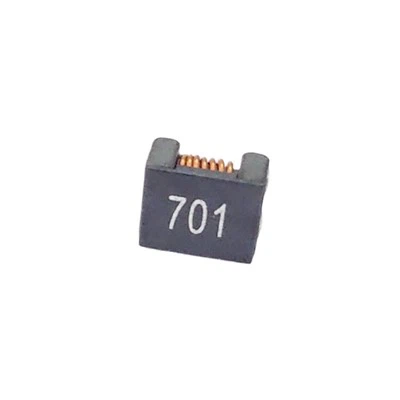
Hey there! As a supplier of SMD inductor coils, I often get asked about the quality factor (Q) of these little components. So, I thought I'd take a few minutes to break it down for you.


First off, what exactly is the quality factor (Q) of an SMD inductor coil? Well, in simple terms, Q is a measure of how efficient an inductor is at storing and releasing energy. It's a ratio of the energy stored in the inductor's magnetic field to the energy lost as heat in the coil's resistance. A higher Q value means the inductor is more efficient, with less energy being wasted as heat.
Let's dive a bit deeper into how Q is calculated. The formula for Q is Q = 2πfL/R, where f is the frequency of the alternating current (AC) passing through the inductor, L is the inductance of the coil, and R is the resistance of the coil. As you can see, Q is directly proportional to the inductance and the frequency, and inversely proportional to the resistance.
So, why does Q matter? Well, in many applications, a high Q inductor is desirable because it can help improve the performance of the circuit. For example, in radio frequency (RF) circuits, a high Q inductor can help filter out unwanted frequencies and improve the selectivity of the circuit. In power supply circuits, a high Q inductor can help reduce power losses and improve the efficiency of the power conversion.
Now, let's talk about some factors that can affect the Q of an SMD inductor coil. One of the main factors is the type of core material used in the inductor. Different core materials have different magnetic properties, which can affect the inductance and the resistance of the coil. For example, ferrite cores are commonly used in SMD inductors because they have high magnetic permeability, which can help increase the inductance of the coil. However, ferrite cores also have some losses, which can reduce the Q of the inductor.
Another factor that can affect the Q of an SMD inductor coil is the winding design. The number of turns, the wire gauge, and the winding pattern can all affect the inductance and the resistance of the coil. For example, a coil with more turns will generally have a higher inductance, but it will also have a higher resistance, which can reduce the Q. On the other hand, a coil with a larger wire gauge will have a lower resistance, but it may also have a lower inductance.
At our company, we offer a wide range of SMD inductor coils with different Q values to meet the needs of various applications. For example, our CD Series 32 Inductors are designed for high-frequency applications and have a high Q value. These inductors are made with a ferrite core and a low-resistance winding, which helps to improve the efficiency of the circuit.
Our CD Series 73 Inductors are another great option for applications that require a high Q value. These inductors are designed for power supply circuits and have a high saturation current, which means they can handle a large amount of current without saturating.
If you're looking for an SMD inductor coil with a medium Q value, our CD Series 54 Inductors are a good choice. These inductors are designed for general-purpose applications and have a balanced combination of inductance, resistance, and Q value.
In conclusion, the quality factor (Q) of an SMD inductor coil is an important parameter that can affect the performance of the circuit. A high Q inductor can help improve the efficiency and selectivity of the circuit, while a low Q inductor may be more suitable for applications where cost is a major factor. At our company, we offer a wide range of SMD inductor coils with different Q values to meet the needs of various applications. If you're interested in learning more about our products or have any questions about the quality factor of our SMD inductor coils, please don't hesitate to contact us. We'd be happy to help you find the right inductor for your application.
References:
- "Inductor Basics" by Electronics Tutorials
- "RF Inductor Design" by Analog Devices