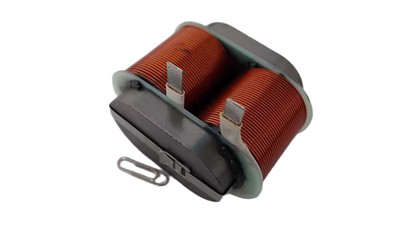
The inductor formula is characterized by two distinct mathematical frameworks: the circuit-level constitutive relation $V = L \frac{di}{dt}$ and the physical-material derivation $L = \frac{N^2 \mu_0 \mu_r A}{l}$. In high-performance power electronics, the idealized constant $L$ is a theoretical abstraction that fails under the pressure of the magnetic saturation bottleneck. As current density increases, the flux density $B$ approaches the material's saturation limit $B_{sat}$, causing a non-linear collapse in permeability $\mu_r$ and a subsequent loss of inductive reactance.
For a Senior Process Architect, the inductor formula is less about a static value and more about managing the energy density gradient. The fundamental constraint is that the energy stored, $W = \frac{1}{2} L I^2$, must be contained within a volume dictated by the core's cross-sectional area $A$ and magnetic path length $l$. Synthesizing a solution requires a deep understanding of how material chemistry affects the $B-H$ loop, where the trade-off between high initial permeability and hard saturation limits the transient response of the system.
Physical Synthesis and Geometrical Constraints
The derivation of inductance from physical parameters, $L = \frac{N^2 \mu A}{l}$, reveals the quadratic scaling of turns ($N^2$) relative to the linear scaling of permeability ($\mu$). In high-frequency GaN-based converters, minimizing the footprint requires maximizing $\mu$, yet high-$\mu$ materials typically exhibit lower $B_{sat}$ values. This quantified constraint forces an engineering compromise: increasing the number of turns $N$ to achieve a target $L$ raises the DC resistance (DCR) and exacerbates the proximity effect, leading to thermal failure at the copper-core interface.
To calibrate the inductor for 1MHz+ switching frequencies, we must account for the effective permeability $\mu_e$ in the presence of an air gap. The introduction of a physical gap or a distributed gap (in powder cores) reduces the overall $\mu$ but linearizes the inductor's behavior. The engineering trade-off here is clear: accepting a lower Inductance Index ($A_L$) in exchange for a significantly higher saturation current ($I_{sat}$), thereby extending the operational range before the $di/dt$ slope becomes uncontrollable.
Benchmark: Material Influence on Inductor Performance
| Material Type | $B_{sat}$ (Tesla) | Permeability ($\mu_r$) | Core Loss Density | Thermal Stability |
|---|---|---|---|---|
| MnZn Ferrite | 0.35 - 0.45 | 2,000 - 15,000 | Ultra-Low | Marginal (<125°C) |
| Nano-crystalline | 1.20 - 1.30 | 10,000 - 100,000 | Low | Excellent (>180°C) |
| Iron Powder | 1.0 - 1.6 | 10 - 90 | High | Superior (>200°C) |
| Alloy Composite | 1.5 - 1.8 | 20 - 120 | Moderate | High |
Energy Density and Dynamic Loss Modeling
In power-dense designs, the inductor equation must be synthesized with the Steinmetz Equation, $P_{core} = k f^a B^b$, to determine the thermal ceiling. As frequency $f$ increases to reduce the required $L$ (and thus the physical size), the core loss density increases exponentially. Quantified results show that at 2 MHz, hysteresis losses can account for over 60% of the total component heat dissipation, necessitating materials with a narrow $B-H$ loop coercivity to maintain high efficiency.
The final engineering trade-off centers on volumetric efficiency versus thermal headroom. While high $B_{sat}$ materials like iron powders allow for massive current ripples without saturation, their higher core loss density often necessitates a larger surface area for cooling, partially negating the size advantage. Therefore, the "formula" for a modern inductor is an iterative optimization of $L(i, f, T)$, where inductance is validated as a function of instantaneous current, switching frequency, and local junction temperature.